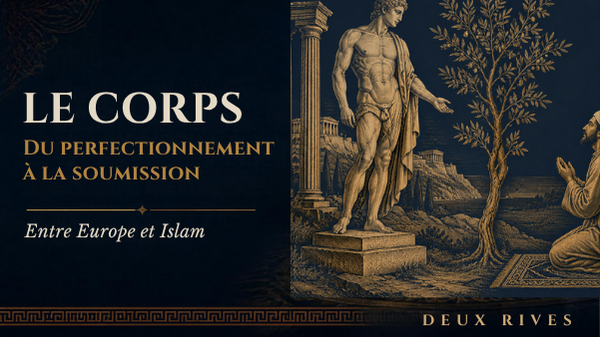
From perfection to submission: the body (between Europe and Islam)
From the ancient games to the inner jihad, the body as an offering, then its modern desacralisation: how Islam awakens Europe's strength.
 Ibrāhīm Barbarūs Al-UrubbiDeux Rives
بِسْمِ ٱللَّٰهِ ٱلرَّحْمَٰنِ ٱلرَّحِيمِ
To perfect one's body the better to submit it: if we had to sum it up, this is the general idea Europe shares with Islam. Submission takes its etymological root from "placing oneself beneath". In this case, beneath God and the spiritual, so as to be its support on earth.
Rather than setting out a dualist plan to present the intrinsic links between the shaping of the body in European and Islamic thought, it is more interesting to interweave the two and to set these visions against an evil that is eating away at the modern world. A symptom of an ever-deepening individualism, and also the consequence of an advanced form of materialism that completely neglects the immaterial: we will study precisely the cult of the body.
I. The body submitted to worship
A. Sport in ancient Europe: a catalyst of virile action towards God
"Res divinae (sacred sacrifice) – such was the character of what corresponds today to sport and the plebeian craze for sport. In the Hellenic tradition, the institution of the most important games was closely linked to the idea of the struggle of the Olympian, heroic and solar forces against the natural and elemental forces."
This was the place of sport in traditional, or ancient, European society. An ascesis, understood as an exercise of the body intended to free the mind. This liberation of the mind through physical trial was spiritually regulated during games for which athletes trained in order to bring glory to their people, their city.
The European's body was an offering in itself, through the devotion he gave to its perfection (so to speak).
The ancient games were entirely a matter of worship as well as culture, and marked a deep attachment to the divine: sport was practised on a foundation of spirituality. The two were intimately linked and every movement was an act of adoration. It was the tradition of action (in the higher sense) that the sporting games of antiquity sought to symbolise and to illustrate through the various trials to which the athletes submitted themselves.
J. Evola, in Revolt Against the Modern World, describes perfectly how the games unfolded and their divine character.
First, it is worth noting that each city had its own arena, which was no small principle. In Rome, the games were always presided over by a representative of the official religion. The link between the games and the divine was so important that preserving the Roman temples was non-negotiable for the Christian rulers if they wished to keep the social peace the ancient games provided.
In the opening quotation we were able to measure the spiritual dimension of the games, if only through the symbolism they deployed. The sporting trials symbolised ancient myths of struggle between heroic forces and elemental forces. Yet the spiritual and higher aspect was not confined to the trials themselves, but extended to their opening, generally marked by sacrifices to invoke divine strength. Nothing was overlooked, not even the architecture of the arenas: the zodiacal twelve, for example, was found in the number of gates through which the chariots entered. Finally, the games ended with rituals in honour of Zeus. A sacred procession led to the temple of Zeus, where crowns were made from a sacred olive tree. The victors received their crowns before the monumental statue of Zeus, a reminder that their victory was a gift of the gods and not merely the fruit of their personal strength.
To return briefly to the athlete himself: in his exercise (ascesis), he sought to embody the heroic figures of the myths in the service of God. Athletes trained in a state of ritual purity.
First, the athlete professed a ritual oath: not to cheat, to respect the rules and to honour the ritual through long and rigorous training. Cheating was considered an offence against the gods, and therefore a sacrilege.
More ascetic features were also often attested, such as sexual abstinence and restraint in eating. Through this purification, the athlete wished to transform himself into a living offering. Sport practised badly pointed to an unbalanced soul, a point we will return to; sporting performance was therefore to be seen as harmony between body and soul. A sign of the Greek ideal of kalokagathia. Among the Romans, physical exercise developed courage, uprightness and self-mastery.
In short, to return to the games, victory was never seen as that of a lone individual. As we have already stressed, it was intimately linked to divine protection and support which, in triumph, brought enormous spiritual prestige to the victor's city.
After this brief introduction to the games and the importance of sport in antiquity, we think it important to look at another form of action in which European ascesis left its mark: the battlefield.
In the age of Norse mythology, war was seen as the means for man to accomplish action in its purest and highest sense. On the battlefield, the warrior was chosen by the Valkyries (supernatural women in the service of God) to join the dead. Once he had died, they carried the hero's soul to Valhalla or to Fólkvangr, depending on whether Odin or Freyja had chosen him. To enter Valhalla, the highest degree of the world of the dead, one had to die weapon in hand (or in combat). There the warrior lived an almost eternal happiness (we will not go into detail on the Norse tradition, as it is not especially relevant here). These warriors formed the elite army of the supreme God.
A somewhat subtler parallel can be drawn with the Keres of the Greeks who, unlike the Valkyries, do not choose the dead but simply feed on the blood of slain warriors, carrying their souls off to the underworld. However, the great warriors who died in battle (such as Achilles or Ajax) went to the Elysian Fields, a place of eternal, luminous and peaceful rest.
Finally, among the Romans, warriors did not die spiritually either, but sometimes joined the divine realm alongside the other gods. Only later, under the influence of Mithraism, did the Romans adopt an idea similar to Valhalla.
B. The Islamic healthy body and healthy mind
The comparative analysis with which we closed the previous part is all the more interesting when we look at the Islamic idea of war. The term used to signify this Islamic "war", "jihad", has crossed everyone's mind, sometimes stirring adrenaline, often stirring fear, depending on where one stands on the globe. Yet the meaning of the word itself has nothing frightening about it. Effort, struggle, resistance: that is what this word means, far from the idea of "holy war" that the West propagates.
This Islamic struggle has absolutely no value if it is not first and foremost an inner combat! Returning from one of his expeditions, the Prophet (peace and blessings be upon him) said to his Companions: "We have returned from the lesser jihad to devote ourselves to the greater jihad."
The lesser jihad represented outward war, whereas the greater jihad was the struggle against the weaknesses of the nafs. While jihad against oneself can have value even without any outward battle, material jihad has no value unless it is marked by an intention of inner struggle. The spiritual and higher dimension of action is fully present!
Jihad can mean striving through speech, the hand, wealth and the pen in order to combat the nafs, sinners, innovators, hypocrites and disbelievers, so that the word of Allah may be the highest.
"And prepare against them whatever you are able of power and of steeds of war, by which you may terrify the enemy of God and your enemy [...]"
Far from deadly ideologies, Islam says: Muslim, train yourself!
There are several reasons why the Muslim must practise physical exercise. First, he must know that his body is an amāna (a trust) from Allah, for which we will have to give account. Indeed, it is reported that the Prophet (peace and blessings be upon him) said: "[...] Fast and eat, pray and sleep, for your body has a right over you [...]"
On the Day of Judgement, we will give account of what we have done, including with our own body (of which, in reality, we are not owners but only tenants). It is a vehicle that carries us from birth to death, and we must take care of it all along the road, because the state in which we present it on arrival may be decisive.
This is why Islam not only sets out prescriptions on food (not eating to excess) but also on physical activity.
And precisely because our body has a right over us, most scholars have agreed to forbid boxing, especially in competition, and other sports that cause very serious harm to the human body.
Beyond that, the Prophet (peace and blessings be upon him) himself said: "When one of you fights, let him avoid striking the face [of his opponent]." This is in truth great wisdom, since the face houses many sensory organs that blows to the face could damage.
However, apart from the Islamic prohibitions on certain sports, the Prophet (peace and blessings be upon him) encouraged mastery of certain physical activities, more precisely five main ones: swimming, archery, horse riding, running and wrestling.
The Prophet (peace and blessings be upon him) said: "Everything in which there is no remembrance of Allah is idle play or heedlessness, except four things: a man walking between two targets (*), training his horse, playing with his wife, or learning to swim."
As for wrestling, the Prophet (peace and blessings be upon him) wrestled Rukana, a man renowned for his strength, and defeated him several times.
Archery is a noble sport and reveals far more about the nature of the Prophet (peace and blessings be upon him) than it might seem. This practice, common to all traditions, is in fact the mark of the warrior caste, of the nobility. The same goes for horse riding.
Finally, and to strengthen our point further, let us recall that the Prophet (peace and blessings be upon him) told us that it is better for a believer to be strong than weak. The strength in question was, of course, mainly a matter of faith and character, but it is naturally tied to its material counterpart, physical condition, insofar as God allows us to reach excellent form.
II. The cult of the body
A. The desacralisation of physical action
From a body submitted to worship through its perfection and greatness, Europe turned towards destruction. A body subjected to the mistreatment of the deadly, masochistic ideologies of men who believed that by torturing themselves they would rise above their physical condition. This practice, driven by degenerate Christian currents, sank sporting practice in Europe for centuries, relegating it to the lowest classes and only for the needs of the fields.
This desacralisation of physical action, meant to desacralise the body and so escape it, only strengthened the body's hold over the mind. You do not control a dog by no longer feeding it; you only drive it mad.
The European thought he had rid himself of the body's troubles, but he discovered sickness, weakness, the need to hand physical tasks to others more capable, dependency through slavery. By abandoning the body, the European did not rise as he was led to believe; on the contrary, he lowered and weakened himself. He stripped the healthy body of its nobility and cultivated deadly, unhealthy ideologies born of his degraded body.
He thought he would become strong by neglecting his strength, and in the end submitted to his weakness.
It is precisely because of this desacralisation that the return of sport was an utterly catastrophic phenomenon on the higher plane. Where the masses saw the revival of strength, we saw the assertion of materialism and individualism. It is the final stage of the desacralisation of the body. Those who thought the abandonment of the body was the goal were mistaken.
The goal was to make men forget the higher dimension of exercise, then to bring them back to this activity, stripped of all higher meaning, in order to give them new goals full of illusions: the race for the most beautiful body, the race for material aesthetics.
A new mission to which modern man devotes himself, sometimes putting himself in pitiful conditions far more dangerous than those of someone who simply does no sport (taking anabolic products that destroy man's natural hormone production and often result in either killing him or making him infertile, robbing him, superficially but truly, of his virility).
Modern man, out of the office, loses himself on his treadmill, running without moving forward towards an ideal sold on television. A six-pack by summer, he tells himself. He runs after his dreams, dreams that are not really his own but those society has sold him on social media and in advertising.
This man can now only live through the body he shapes, to compensate for everything he no longer controls in his own life. He numbs himself in the mechanical action of weight training, three sets, twelve reps, Monday to Saturday and so on, comforting himself with the pump of muscular hypertrophy while neglecting the atrophy of his mind.
Here is the final phenomenon, the real one! Ascesis is degraded, trampled, disfigured. It is, according to Evola, the religion of the worker. And how can this be denied? Gym members even sometimes speak of the "temple" of bodybuilding, worshipping their own body in a hall where every gain is a step towards the goal. These members do not even know whether they will live long enough to enjoy the fruits of this diseased tree. And at what price? The price of constant upkeep so as not to lose shape, they will say. That is the poison inside this pretty fruit. Man's point of reference has been lowered entirely, and all that counts for him is the image he projects to others and to himself.
Modern sport is an insult to traditional action. Man believes he is confronting his weaknesses by going to a heated gym with well-maintained machines; he deceives himself and wallows in the false belief that he is at war with himself. If he is, it is because he is actually playing the role of his own enemy, not of the one on the right path.
"Physical individuality, on the contrary, is flattered and strengthened by sport; the chain is thus consolidated and every trace of subtler sensitivity is stifled; man tends to lose his character as an organic being, to be reduced to a bundle of reflexes, almost to a mechanism."
It is also important to note the growth of sports organisations promoted by modern states, which reveals precisely a corruption of the sporting element and above all of action in the higher sense. A total abandonment of personality in the higher sense for an attachment to lower distinctions (who will have the biggest arms).
This proliferation of subsidised activities, allowing the various classes to meet outside the workplace in the temples of sport, should make us question the modern purpose of sport. The meaning it has now been given is political and social; the formula "bread and circuses" fits perfectly, a reminiscence of antiquity, if one wants to be a little cynical.
The sporting events we can see in the various bodybuilding or strongman competitions only confirm this phenomenon of degradation.
It is through the labour of physical action that he imprisons himself; the fever of sport, of desires, of passions, is one expression of it. Only through awareness can the spiritual element be revived, allowing us to go beyond the limits of materiality and of the effects visible in the light of the mirror.
The individual turns into an object of contemplation, like a crustacean whose hardness can only be seen on the shell, though we know the hollow echo inside, the symbol of an emptiness deeper and more real than ever.
The problem lies precisely in the lack of a higher foundation for physical action. Man forgets the essential reason that makes this perfection possible. He is like the gardener who waters his plants and rejoices that they grow, forgetting the essential role of the sun without which his plants would die.
Man's heroic will, unable to express itself in this castrating world, looks for outlets so as not to turn this force against itself.
The individual who wishes to rise should give up sport if he cannot first reach the inner awakening that leads him to the right intention in his actions: the intention which, as we have seen, centres on God and on the active faculty we develop for Him through physical exercise. If this higher character cannot be given to action, then action must be abandoned, for fear of corrupting it a little more each time and, in the end, corrupting oneself.
Modern man believes he fulfils himself in his relationship with his body, while he locks himself into an utterly materialistic and changing vision. He traps himself in the cycle of evolution and involution while thinking he escapes it through physical constraint. The very mechanics of physical activity are marked by emptiness.
It is the active repetition of movements to answer man's desire for change.
Metaphysics can be found in man's will to train his body in order to discipline it, but once again the intention must be there: the intention to do so for a higher purpose and not to satisfy selfish desire (an excessive attachment to oneself).
Here is the very sickness of modern man: sporting practice as a response to the absence of a heroic, active path in our societies. But if this practice is not marked by the will to bring the soul back to the right path, it has nothing in common with the sport of antiquity, even if from the outside the two seem similar or identical. It is only a construction that begins and ends in matter, with no other value. Sensation and exaltation end up in abject materiality.
The same goes for war, which we mentioned earlier and whose modern character is utterly corrupted.
How can man rediscover the higher character of the warrior in our modern conflicts, where no supreme law is respected? Whether it is the presence of women on the battlefield or the military evolution that is turning the battlefield into a confrontation between men and machines (drones, tanks, planes and soon robots?).
Man can no longer fulfil himself in war, first because there is no longer any war leader worthy of the name in whom we can place our body and our faith. The massacre of innocents, secular armies, wars of machines, indiscriminate bombing, the absence of honour, female or sometimes even prepubescent soldiers, wars waged for the profit of industries, banks and other diabolical actors (the word is weak).
B. The body as the foundation of a weakened mind
Yet in our modern societies the body is not only exalted; it is also, very often, neglected!
The bourgeois, in a contempt that is almost genetic in him, neglects his body as if what he was disgusted him (forget "as if"). We have already set out at length our criticism of the members of the temples of sport, but we have said very little about those who take refuge in books, thinking they will find freedom there.
They are no better. Their body influences their mind through weakness and, unless they carry an exceptional zeal within them, they leave courage and strength to others. This bourgeois (who is sometimes only a bourgeois of the mind) cultivates the greatest contempt and the greatest repugnance for any kind of physical discipline.
The pseudo-intellectual neglects the body as if it were a hindrance to him; he sees hunger as a constraint and rest as a punishment, every movement is torture to him, and his complacency comes down to battles of words with no consequence that could turn into a physical confrontation. From then on, the armchair intellectual bristles, takes offence, calls his opponent a savage and an idiot, and completely rejects physical confrontation as if it were the preserve of the weak.
Here is yet another poison that has dissolved into the Western mind! The bourgeois of the mind has built himself a legal shield that lets him spit his venom at people who have few intellectual (or rather verbal) means to respond and who are forbidden to use their own weapons on this unequal battlefield! This is a form of class contempt the Marxist will not look into.
In short, this is precisely where Islam brings a revival of sport in its spiritual dimension, far from a materialist inferiority, beyond the prophetic and Quranic quotations we have already drawn on.
The Quran tells us:
"And my success is only through Allah"
The Muslim athlete, in his physical action (imbued with metaphysics), thanks God and refuses to become proud, at the risk of losing the whole higher dimension of his act.
The first three men who will go to Hell are precisely men who, in their action, corrupted their intention towards God through pride.
In Islam, the strong body benefits the whole community, and it is in this sense that it must be perfected. The niyya (intention) must be turned towards being better able to help, protect and serve others. For it is also through our good deeds that we give a good image.
The Prophet (peace and blessings be upon him) loved strong believers, as we have already seen, because they were useful to society and contributed to the common good.
The Muslim does not fear physical strength, since he commits to mastering it out of the very will to follow the sunna of the Prophet (peace and blessings be upon him). He has been given as a model a wrestler: courageous, strong, disciplined, charismatic, intelligent, tested, the summit of virility in both its etymological and its contemporary sense.
This is how, at the end of this dive into the spirituality of the sporting world, we grasp with greater force (precisely) all the relevance Islam brings to a broken world: a revival of the necessity and importance of divine support in physical exercise (ascesis) in Europe and the world, awakening once again in the Westerner's nature this sporting quality that was once his own and that he has long neglected, even forgotten.
In the end, and to sum up, Islam awakens Europe's strength, put to sleep by the atrophy of the mind, to place it in the service of God.
ٱلْحَمْدُ لِلَّٰهِ